File queued to print
The safety check starts before the job reaches the fabrication controller.
print_job.3mf
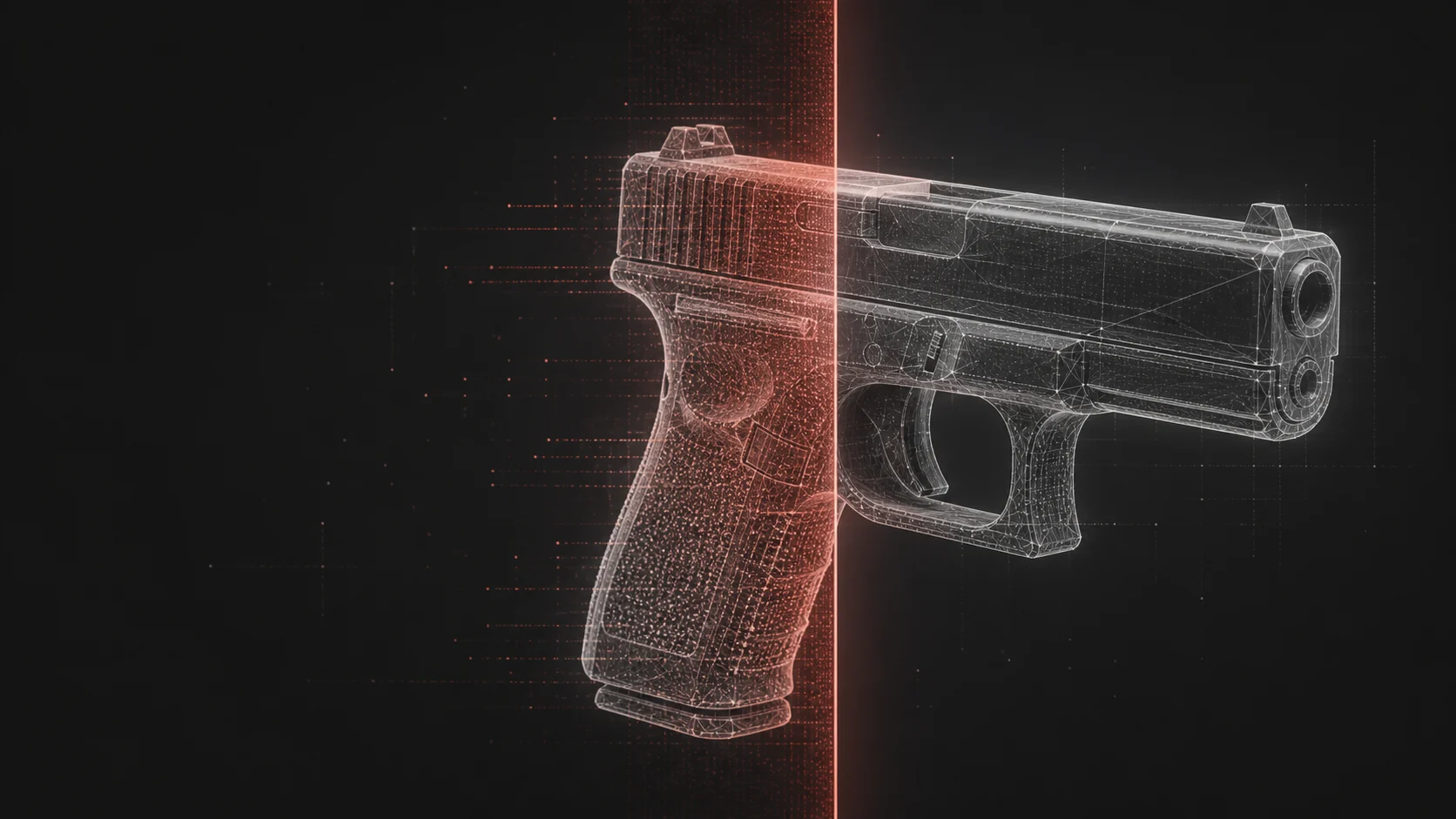
PrintGuard identifies firearm-related risk before a file is published, queued, or fabricated—locally, quickly, and with an auditable record.
01 The system
PrintGuard can run as a cloud service called through an API or directly on printer hardware. Either way, the same classifier screens each file before fabrication and only releases jobs that clear the configured firearm-part policy.
The safety check starts before the job reaches the fabrication controller.
print_job.3mf
02 / Choose deployment
Slicers, marketplaces, and print services send the file to a managed screening endpoint.
POST /v1/classify
The classifier executes on the printer or local controller without sending the file to the cloud.
LOCAL / NO UPLOAD
The classifier reads the shape itself—not the filename—and scores the file before any print motion is authorized.
04 / Enforce before print
The job continues only after it clears the active classification and policy line.
Hold, block, or route according to jurisdiction-specific rules and workflow.
Bounded parsers validate STL, OBJ, AMF, 3MF, and OFF files before analysis.
Mesh statistics, point clouds, voxel occupancy, and multiview projections capture the durable shape signal.
Scores, evidence, thresholds, and the resulting pre-print action are retained in a decision record.
02 The gap
Names can be changed in seconds. Keyword filters confuse intent with a label.
A small file edit produces a new hash, even when the underlying geometry is effectively unchanged.
PrintGuard extracts mesh statistics, sampled points, voxel occupancy, and multiview projections from the file itself.
03 Benchmark snapshot
A source-separated test set of firearm designs, firearm-specific parts, dual-use parts, near-firearm duplicates, and benign 3D files.
Percentage of firearm files successfully flagged.
Benign files incorrectly flagged. Lower means less friction for lawful use.
Per file, for average file sizes.
Source-separated test set.
V1 benchmark · July 2026
04 Built to be credible
PrintGuard is built around documented datasets, source-separated testing, clear audit records, and human review.
mesh rows in the binary training manifest
benign mechanical examples selected to challenge the classifier
positive mesh examples from authorized channels
Screening can happen where files already live, without centralizing every design.
Hashes, model scores, evidence, and decisions create a reviewable record.
Ambiguous and high-impact decisions can move into a review workflow.
Models, benchmarks, and policy rules can be updated as evidence improves.
05 Policy landscape
PrintGuard tracks 2025–26 measures that expressly address printer blocking, 3D firearm manufacture, digital instructions, or serialization, together with selected related laws already in force.
Scope: 2025–26 state measures expressly addressing printer blocking, 3D firearm manufacture, digital instructions, or serialization, together with selected related laws already in force. Map color reflects the most advanced listed measure. This focused tracker does not attempt to catalog every general firearm or ghost-gun bill. Each linked measure has substantive language within this scope; bills that merely repeat an existing definition are excluded. It is informational, may not be exhaustive, and is not legal advice. Statuses last reviewed August 12, 2026.
06 Where it fits
Evaluate product-level safeguards against emerging performance requirements.
Email 02Screen files before slicing or publication, close to the existing workflow.
Email 03Job-level intake controls for universities, makerspaces, and enterprise teams.
Email 04Support consistent file review while limiting unnecessary redistribution of sensitive CAD files.
Email07 In the public record
Independent coverage of untraceable firearms, the rise of 3D-printed weapons, and emerging policy responses.
Reporting on New York’s first-of-its-kind requirement, the technical questions it raises, and the emerging standards debate.
Read the report Opens in a new tab Associated Press · October 16, 2025A look at recoveries reported by roughly two dozen police departments, cheaper fabrication tools, and concern about a new wave of homemade weapons.
Read the report Opens in a new tab Capitol News Illinois via NPR Illinois · June 12, 2026Reporting on a federal conviction and the enforcement challenges surrounding increasingly sophisticated home gun-making.
Read the report Opens in a new tab NJ Spotlight News / PBS · April 16, 2024Statehouse reporting on crime-gun recoveries, 3D printing, conversion devices, and pressure on existing statutes.
Watch the report Opens in a new tabA practical middle path
We are building a practical screening layer for additive-manufacturing workflows—designed to reduce risk without adding unnecessary friction for lawful use.
